
Silenced voices: Imo school for the deaf where students battle neglect, rape
Motorists speeding along the constantly busy Owerri-Orlu Road may easily overlook the worn signpost indicating the Imo State Secondary School for the Deaf, Ofekata Orodo, located in the Mbaitoli Local Government Area.
Similar to the institution it represents, the signpost has faded into obscurity, neglected, forgotten, and gradually deteriorating.
Its weathered frame, peeling paint, and indistinct lettering serve as a silent testament to years of disregard, providing only the faintest hint of the poignant narratives and harsh realities concealed beyond its gates.
Nevertheless, the signpost conveys merely a fragment of the entire narrative.
Nothing can adequately prepare a first-time visitor for what awaits beyond the entrance. Behind the dilapidated walls lies a haunting depiction of neglect, decay, and forsaken aspirations, where children with hearing impairments strive to learn in conditions that betray every commitment to dignity, safety, and inclusive education.
The facility is in a condition worse than a pigsty. Yet, within its crumbling confines are nearly 150 students whose resolve to learn remains unshaken, holding onto education as perhaps their sole hope of transforming their narratives.
Beyond the rusting gate lies not just a neglected public school but a forgotten realm where children exist in silence, not merely due to their inability to hear or speak, but because those responsible for their care have, for decades, turned a blind eye.
For many of these children, their most significant burden is not deafness. It is abandonment.
Some were brought here by parents and relatives who perceived their disability as a family secret best concealed from neighbors and friends.
Once admitted, many were simply left behind, seldom visited, if at all, while their presence was quietly erased from family life.
From a distance, the sprawling school almost deceives the observer.
Rows of towering palm trees gently sway across the vast compound, casting long shadows that impart a sense of tranquility to the surroundings. They create the illusion of a peaceful learning environment.
That illusion vanishes almost instantly.
Deserted school, overlooked students
Founded in 1984, the mixed secondary school once epitomized opportunity.
It was established to provide children with hearing impairments access to quality education, guided by specialist teachers trained in sign language and deaf education.
For numerous families, it stood as evidence that disability need not dictate one's future. Today, that promise is gradually fading.
There was no security guard, gatekeeper, or anyone to oversee who entered or exited the premises.
Just beyond the black gate lay a sprawling palm plantation covering several plots of land to the right, while the classrooms, hostels, and administrative buildings quietly stood to the left, bearing the unmistakable marks of neglect.
After briefly admiring the beauty of the palms, the harsh reality became impossible to overlook.
The gatehouse, as our correspondent discovered, had been long abandoned, remaining empty since the last security personnel's retirement.
Nearby, broken taps, seemingly vandalized, lay like remnants of a bygone era.
It was reported that there was no running water anywhere on the premises. Ironically, the classrooms themselves were immaculate.
The floors were meticulously swept, with hardly a piece of litter in sight. The atmosphere was unusually tranquil, interrupted only by the soft sounds made by the students and the graceful movements of their hands as they communicated fluently in sign language.
Their silence was striking. Yet it conveyed a great deal.
One of the first things a visitor observes is the extraordinary bond between the students and the few caregivers who continue to care for them despite the challenging conditions.
They laugh, tease each other, and offer comfort. Their conversations flow seamlessly through expressive signs and facial expressions.
However, for those who are not acquainted with sign language, they find themselves confined behind an unseen barrier, striving to express a reality that words can scarcely convey.
Through their gestures, they narrated tales of neglect, hunger, isolation, and parents who seldom visited them.
From observation, what should ideally function as a school has gradually transformed into a holding facility where numerous families leave children they neither know how to care for nor wish to, safely concealed from prying eyes back home.
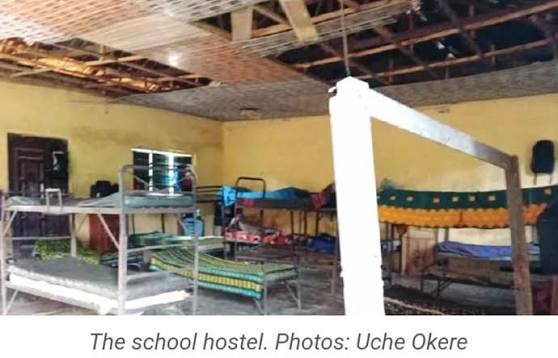
The hostels reveal another sorrowful narrative. Fewer than 20 beds accommodate nearly 150 students.
Many are compelled to adapt their sleeping arrangements, cramming into any available space.
Yet, in spite of the evident overcrowding, little seems to have changed over the years.
Electricity has long since faded into memory. Power poles within the premises have been vandalized, and electrical cables were stripped away long ago, leaving the school in a state of perpetual darkness once night descends.
Raped, hungry
Almost every building shows the marks of repeated vandalism. Many classrooms and hostels have lost their doors.
According to one caregiver, the absence of doors serves as proof of years of continuous break-ins by criminals, during which some female students were allegedly sexually assaulted.
Yet, beyond the shattered walls lies an even more profound crisis. The students struggle against hunger. They contend with abandonment by the government and, in many instances, by their own families.
They exist without sufficient security. Teachers remain unpaid. Hostels are in decline.
Staff quarters are deteriorating. Classrooms are crumbling. Even education, the very purpose of the school, is gradually fading away.
It has been reported that students now receive instruction only in core subjects, while Physics and Chemistry have entirely vanished from the timetable due to a lack of qualified teachers or functional laboratories.
Using sign language, one caregiver clarified that the school continues to adhere to the same curriculum as traditional secondary schools.
The sole distinction lies in the absence of specialist teachers and laboratory facilities essential for instructing science subjects.
Previously, the school employed several specialist educators specifically trained to teach children with hearing impairments.
However, these educators retired one after another without any replacements.
Over time, the school not only lost its staff but also the specialized support system that had once made it a beacon of hope for children with hearing impairments. Currently, only a few teachers remain.
The students faced limited options. They simply adapted, adjusting to life in an environment where silence is characterized not only by deafness but also by years of neglect that are slowly extinguishing their aspirations.
Teachers decline postings
According to a caregiver, who requested anonymity due to lack of authorization to speak, teachers assigned to the school often begin seeking transfers almost immediately upon arrival, unwilling to endure the harsh conditions that have become the daily reality for the students.
A teacher, who also spoke on the condition of anonymity for fear of repercussions, reminisced about a time when the school attracted highly qualified specialist educators.
The teacher noted that the position once included special allowances in recognition of the unique skills required to educate children with hearing impairments. However, when these incentives were eliminated, many seasoned teachers gradually lost interest and departed.
"The interest faded," the teacher stated softly.
Intimidated into silence
The teacher further disclosed that after members of the Ratels Group visited the school and released a viral video highlighting its dire conditions, staff members found themselves under severe scrutiny.
Instead of receiving promises of intervention, they were met with warnings.
According to the source, teachers and caregivers were advised against discussing the school's conditions with outsiders, with threats of sanctions looming over anyone who spoke publicly.
No operational toilets
As our correspondent traversed the compound, another alarming reality came to light.
Beyond the unkempt surroundings and deserted buildings, a sanitation crisis unfolded.
Human waste was scattered across various areas of the premises. There was not a single functional toilet in sight, and clean running water was nearly absent.
Caregivers were observed returning from nearby communities, carrying heavy buckets of water on their heads after walking long distances.
They explained that the water was utilized for cooking and, when feasible, for bathing the children.
The situation depicted a struggle for survival rather than a focus on education.
Public outrage
In the meantime, the state of the school has sparked a blame game among public officials following a public outcry after videos revealing its dire condition went viral.
When reached for comment, Innocent Ik