

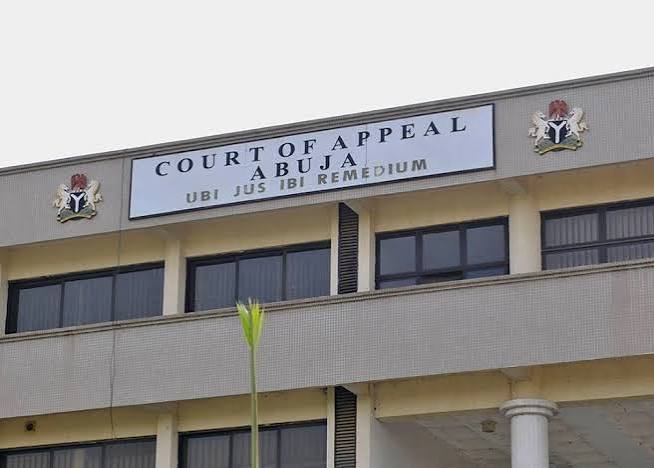
Deregistration of ADC, others was judicial rascality — A-COURT
The Court of Appeal in Abuja has annulled the judgment that mandated the Independent National Electoral Commission (INEC) to deregister the African Democratic Congress (ADC) along with four other political parties, which were accused of not fulfilling constitutional requirements. The court characterized Justice Peter Lifu's actions as judicial misconduct and impertinence.
The other parties affected include the Action Peoples Party (APP), Action Alliance (AA), Accord Party (AP), and Zenith Labour Party (ZLP).
It is important to note that Justice Lifu had issued the order to deregister these parties, despite a prior directive from the appellate court on May 22, which instructed him to suspend proceedings in the matter until the appeal by the parties was resolved.
In a unanimous ruling delivered by a three-member panel of Justices yesterday, the appellate court determined that the order issued by the Federal High Court on June 15 was void.
The court concluded that the High Court had improperly assumed jurisdiction and issued the order based on an invalid suit filed by a non-juristic entity.
In response, the ADC quickly labeled the ruling as a rectification of a miscarriage of justice and commended the Appeal Court for its decision.
Senator David Mark, the National Chairman of ADC, referred to the attempt to deregister the party as an attack on democracy. Meanwhile, Atiku Abubakar, the presidential candidate for the 2027 elections, emphasized that the upcoming election should be decided at the ballot box rather than in court.
Osun State Governor Ademola Adeleke, who is seeking re-election under the Accord Party, stated that the ruling has effectively quashed attempts to exclude him from the ballot.
The appellate court asserted that there was no legitimate suit that could justify the consequential order directing INEC to disband the political parties. It highlighted that the trial court had failed to adequately assess the evidence presented, particularly neglecting the fact that the parties had secured various seats in previous elections.
The court also determined that the High Court acted in violation of an order that mandated it to suspend proceedings in the matter.
It concluded that the High Court should have dismissed the substantive case due to a lack of jurisdiction and merit.
As a result, the appellate court, in its principal judgment delivered by Justice Abba Mohammed, affirmed that all the implicated political parties remained properly registered.
It granted separate appeals submitted by the political parties and imposed monetary costs against the National Forum of Former Legislators (NFFL), which initiated the case against them.
It is noteworthy that the appellate court had, on June 16, issued a stay of execution of the High Court's judgment, while also reprimanding the trial judge for ignoring the judicial hierarchy.
The panel criticized Justice Peter Lifu of the Federal High Court in Abuja for failing to comply with an order it had issued on May 22, which instructed him to suspend proceedings in the case until the appeal by the parties was resolved.
It observed that although the trial judge had been made aware of the order for a stay of proceedings, he willfully disregarded it and proceeded to deliver a judgment.
The court stated that Justice Lifu's conduct was "a form of judicial impertinence," emphasizing that the Supreme Court had previously ruled that a judge who behaves in such a manner "is unfit for the bench, as such conduct constitutes judicial rascality."
The High Court had instructed INEC to deregister the five political parties, asserting that they had not fulfilled the constitutional requirements necessary for their continued existence and participation in future elections.
Additionally, it prohibited INEC from granting further recognition to these parties, accepting candidate nominations from them, or allowing their activities to proceed in relation to the 2027 general elections.
Justice Lifu directed the defendants to cease presenting themselves as registered political parties in the country, stating that he found merit in the lawsuit filed by the NFFL.
In the case identified as FHC/ABJ/CS/2637/2026, the NFFL requested the court to ascertain whether INEC is constitutionally obligated to disband political parties that do not fulfill the electoral performance criteria established in Section 225A of the 1999 Constitution (as amended), which is further supported by the Electoral Act 2022 and INEC’s regulations.
The plaintiffs contended that the five political parties named as defendants had consistently failed to satisfy the constitutional standards necessary for maintaining their registration.
The former lawmakers emphasized that these requirements include obtaining at least 25 percent of the votes in a state during a presidential election or securing at least one elective position at the national, state, or local government level.
They informed the court that the ADC and the other four parties had underperformed in both the 2023 general elections and the by-elections conducted by INEC, resulting in their failure to secure seats across significant levels of government.
The litigants asserted that the ongoing recognition of the ADC and the other defendants as political parties was unlawful and compromised the integrity of the nation’s electoral framework.
Significantly, the Attorney General of the Federation and Minister of Justice, Prince Lateef Fagbemi, SAN, who is also a defendant in this case, supported the plaintiffs' position.
In documents submitted to the court, the AGF contended that the continued existence of these political parties contravened the existing provisions of the 1999 Constitution (as amended) and ultimately jeopardized the electoral integrity of the nation.
The AGF maintained that without judicial intervention, INEC would persist in violating its constitutional responsibilities by retaining parties that have not met the legally mandated minimum requirements.
However, dissatisfied with the ruling of the trial court, all defendants, including INEC, appealed to the appellate court to overturn the decision.
ADC stated that the verdict rectified a significant miscarriage of justice.
In response to yesterday's verdict, the African Democratic Congress (ADC) expressed its approval, stating that the appellate court determined that trial judge, Justice Peter Lifu, had fabricated evidence to favor the plaintiffs.
The party, through a statement issued by the National Publicity Secretary, Mallam Bolaji Abdullahi, asserted that the appellate court's ruling confirmed the ADC's longstanding belief that the lawsuit was legally unsound, lacking evidential support, and incapable of yielding a legitimate judgment.
Abdullahi remarked: "The ADC also finds it remarkable that the Court of Appeal identified Justice Peter Lifu's fabrication of evidence in resolving the matter in favor of the plaintiff.
"We believe this issue strikes at the core of the judiciary's integrity and the judicial process. It is noteworthy that this marks the second occasion in cases involving the ADC where Justice Peter Lifu has faced serious condemnation from the superior court for willful disobedience, judicial insubordination, and impertinence.
"Consequently, we question whether a judge with such a tarnished reputation should be permitted to remain on the bench, even for an additional day.
"In dismissing the case due to lack of jurisdiction, the Court of Appeal stated that the plaintiffs failed to establish any legal interest unique to themselves, instead relying on speculative claims that they had previously participated in elections and might do so again in the future, which the court deemed inadequate to warrant its jurisdiction.
“We consider this judgment significant, not merely because it restores the rights of the affected political parties but because it reinforces an enduring constitutional principle: that judicial authority must always be exercised within the bounds of the law, in obedience to superior court orders, and on the basis of evidence properly before it.
“The ADC has always maintained its confidence in the judicial process. We are gratified that the Court of Appeal has reaffirmed the rule of law, corrected a grave miscarriage of justice, and protected the constitutional rights of political parties against unlawful interference.”
ADC deregistration bid was assault on democracy, David Mark declares
Similarly, the National Chairman of the party, Senator David Mark, declared that the failed attempt to deregister the party was ‘a direct assault on multiparty democracy,’ hailing the Court of Appeal for the ruling.
Mark, in a statement signed by his Special Adviser on Media and Publicity, Kola Ologbondiyan, described the Court of Appeal’s verdict as a victory for the ADC, democracy, constitutionalism and the rule of law, saying it reaffirmed the judiciary’s role as the guardian of democratic values.
“The attempt to deregister the ADC was a direct assault on multiparty democracy and an unfortunate effort to undermine the constitutional right of Nigerians to freely associate and participate in the political process,” Mark declared.
He argued that the implications of the judgment extended far beyond the fortunes of the ADC.
He said it had strengthened c