

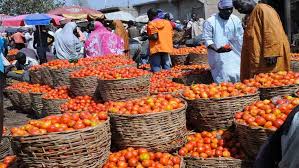
Sallah: Households groan as tomatoes turn stew into luxury
A few days before the Sallah celebration, Mile 12 Market bustled with buyers and traders haggling over prices across crowded stalls.
Amid the noise, Rukayat Bello stood quietly, repeatedly adjusting the edge of her scarf as she counted the N1,000 notes in her purse.
“One, two, three, four…,” she murmured, staring at the tomatoes displayed in plastic bowls of various sizes.
After counting her money, she pulled out N7,000 and quietly reduced the quantity of tomatoes she intended to buy.
Bello had arrived at the market hoping to buy enough foodstuffs, including tomatoes and pepper, ahead of the forthcoming Sallah celebration. But after asking for the prices, her plans changed instantly. What once cost a few thousand naira now consumes almost half of her budget for food.
“I could not believe that just five pieces of tomatoes would cost N1,000. Before, I used to buy baskets during festive periods without thinking too much about it, but now everything is too expensive. We are just managing to cook what we can afford,” she said in an exasperated tone.
Not too long ago, tomatoes and peppers were among the cheapest items most households could afford. But today, they are bought in tiny portions, or abandoned altogether as soaring prices continue to strain household budgets.
Shift to cheaper tomatoes, pepper
For Esther Inyang, survival now means mixing fresh tomatoes and peppers with cheaper, partially spoiled ones to cut costs.
According to her, the strategy allows her to save some money for other household needs instead of spending everything on cooking ingredients alone.
The mother of four said she had hoped to prepare a proper meal for her children during Sallah, but the rising cost of tomatoes and pepper forced her to reduce the quantity of food she planned to cook.
“I intended to cook well for my children during this Sallah, but had to reduce the quantity because tomatoes alone consumed most of my budget,” Inyang lamented.
She lamented that the rising prices of tomatoes and peppers have become increasingly unbearable for households already struggling under the weight of the country’s harsh economic realities.
According to her, some food ingredients once regarded as ordinary kitchen essentials have now become luxury items for many families.
“Buying tomatoes and peppers now feels like buying gold. Before, with N3,000, I could prepare a decent pot of stew for my family, but now the same money can barely buy enough ingredients. Sometimes, I reduce the quantity of food I cook because everything in the market has become too expensive.”
As it stands, across major markets in Lagos, Ogun, Oyo, and other states, consumers and food vendors are grappling with soaring food prices, worsened by increased demand as the festive period approaches.
In a survey conducted by our correspondent, a small plate containing about five tomatoes now sells for between N500 and N1,000, while a paint bucket of tomatoes costs as much as N10,000 to N15,000, depending on the quality and location of the market.
For instance, a Lagos resident, Queeneth Ojogbile, who regularly shops at Mile 12 Market, said tomato and pepper prices have risen sharply within the last two months, making basic food preparation significantly more expensive for many households.
We now buy in portions
She explained that a crate of tomatoes, which previously sold for about N10,000 and could sometimes be negotiated down to N9,000, now goes for as high as N30,000.
According to her, even smaller measurements in bowls and miniature buckets have recorded similar increases.
Ojogbile noted that many buyers now resort to pooled or shared buying arrangements because of the soaring prices.
She, however, lamented that her N5,000 contribution in one of such arrangements yielded far less than what the same amount used to buy in the past.
“For instance, a crate of tomatoes, which is typically the standard measure for bulk buying, used to sell for about N10,000 and could sometimes be negotiated down to N9,000. However, during my last visit to the market, I was shocked to find the same crate selling for as high as N35,000.
“I do not usually buy the basket size, but even that has also changed. Earlier, baskets sold at much lower prices, but when I got to the market recently, one cost about N8,000. It was only then that I fully understood the scale of the increase, as I could no longer afford the quantity I used to buy with N10,000. Because of the high prices, I had no choice but to join others in what we call shared buying.
“People now pool money together, some contribute N10,000 or N30,000, to buy in bulk and then share among themselves. I contributed N5,000 so I could be included in the sharing, but what I received was very small compared to what that same amount used to fetch. Before, when we pooled money like this, sellers often added extra portions after sharing, but this time there was nothing extra at all,” she lamented.
The housewife added that food items which previously lasted several days, now finish within a day, forcing many families to make repeated trips to the market for restocking.
“It has really affected the cost of living because we now spend more just to cook basic meals. Whatever is prepared only lasts for a day, and the cycle continues. The situation is becoming very difficult, and it feels like both the rich and the poor are under pressure,” she added.
Household realities
Findings by Sunday PUNCH showed that many households have scaled down their consumption of tomatoes and peppers, now purchasing them in much smaller and more carefully rationed quantities.
A small plate containing about five tomatoes, which previously sold for between N200 and N250, now sells for as high as N1,000. A paint bucket of tomatoes now goes for between N12,000 and N15,000, compared to its previous price of about N5,000.
Similarly, the price of pepper has risen from about N3,500 per paint bucket to N8,000.
Traders also disclosed that a crate of tomatoes, which previously sold for between N8,000 and N15,000 depending on quality and season, now sells for between N25,000 and N35,000 in several urban markets.
Traders battle rising costs
Traders across different markets also lamented that rising wholesale prices have forced them to increase retail prices.
According to them, the situation is being driven by supply shortages and high demand due to Sallah.
One of the traders, Musa Yahaya, explained that while prices continue to rise at the wholesale level, customers often accuse retailers of making excessive profits, a claim he strongly denied.
He said, “I sell according to the amount I buy them. They are already expensive when we buy them wholesale, and because they are perishable, we cannot afford to sell them cheaply. If they spoil, we lose money.
“A month before Sallah, these items were cheaper, but every time we go to the market, prices increase. Before this festive period, we used to buy a crate of tomatoes for between N25,000 and N30,000, but now it sells for between N80,000 and N90,000.”
Yahaya said the soaring prices have placed both traders and consumers under severe pressure ahead of the Sallah celebration.
“For pepper, we used to buy a sack for between N40,000 and N60,000, but now it sells for between N180,000 and N190,000. The one I bought recently cost N150,000 only because part of it had already spoiled. Right now, onions are cheaper than all of them.
“Ata sombo (red chilli pepper) now costs about N100,000 per sack, compared to N20,000 before, while a sack of tatashe (bell pepper) sells for between N70,000 and N80,000 instead of the former N20,000 to N30,000. Fresh produce is always more expensive.
“I now sell a paint bucket of tomatoes for about N12,000, pepper for N14,000, and red chilli pepper for N10,000. The tomatoes I sell for N3,000 now used to sell for N2,150. The N2,000 portion also used to be N1,000, while the paint bucket size was around N5,000 before,” he explained.
Another trader, Mustapha Abdulkadir, attributed the crisis to poor harvests, rising farming costs, and high transportation expenses from northern states to the South-West.
He lamented that transporters have significantly increased their charges due to rising fuel costs and logistics challenges.
Abdulkadir explained that tomatoes and peppers are usually cheaper and more abundant during the harmattan season, but current off-season production challenges and transportation difficulties have worsened scarcity across markets nationwide.
According to him, farmers now spend heavily on manure and irrigation to sustain crops outside the normal harvest period.
A tomato trader, Mrs Kudirat Afolabi, also said many sellers now incur heavy losses before produce even reaches the markets due to the highly perishable nature of the goods.
“Sometimes, drivers spend days on the road because of insecurity and poor road conditions. By the time the goods arrive, several baskets have already spoiled, and we have no choice but to increase prices to survive,” she said.
Although tomatoes and peppers are cultivated across Nigeria’s 36 states for local consumption, large-scale commercial farming remains concentrated in the northern region, particularly in Kaduna, Kano, K