

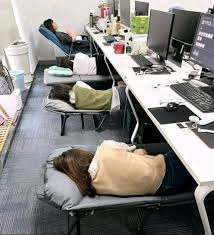
Transport costs: Sleep suffers as workers turn offices into homes
While most residents of Lagos Island were just beginning to stir from sleep at about 5:30 a.m., 28-year-old bank worker, Samson Adeyemi was already in the restroom of his office building, hurriedly brushing his teeth before colleagues arrived.
For nearly eight months, the customer service officer had turned a small corner of his office into a makeshift bedroom.
Unable to cope with the rising cost of transportation and accommodation in Nigeria’s commercial capital, he spends most weeknights in the office.
“I leave the office around 6 p.m. and resume by 7 a.m. the next day. If I go home to Ikorodu every day, I could spend over four hours in traffic and spend around N5,000 on transport daily. My salary cannot comfortably cover it anymore,” he told PUNCH Healthwise.
While the arrangement helps him save money from his N130,000 monthly salary, it comes at a personal cost
Adeyemi said he rarely gets uninterrupted sleep because cleaning staff and overnight activities in the building frequently disturb his rest.
“You can never really sleep deeply or have quality sleep. I have to hide and wait till everyone leaves the building before I can prepare to sleep. Some of our bosses work late into the night, some leave the office around 10 or 11 pm.
“The air conditioning is turned off at night, and there is no proper place to lay your head. I sleep on an uncomfortable office chair. Also, security personnel move around the office building at night, and I have to avoid being caught. I wake up tired almost every day,” he lamented.
Beyond sleep deprivation, maintaining personal hygiene has become another daily struggle.
“There are days I cannot bathe properly before work because the office restroom is always busy early in the morning. Sometimes, I just wash my face and wear the same trousers longer than I should because carrying many clothes around is difficult,” Adeyemi said.
Unrefreshed sleep
Another employee of one of the first-generation banks, Chidinma Francis, faces a similar reality of waking up unrefreshed during weekdays.
After the removal of fuel subsidies and repeated increases in transport fares, commuting from her parents’ residence in Mowe, Ogun State, to Lagos Island became financially draining.
Unable to afford rent closer to work and unwilling to spend several hours in traffic daily, she began sleeping in the office.
The 26-year-old operations officer said, “There is no designated room or resting area. Most nights, I spread clothes on the floor just to sleep on. If you do not want to sleep on the floor, the alternative is to sleep on your desk, which is also uncomfortable. When I wake up in the morning after sleeping on my desk, I do have neck pain.
“Every time I get home on Fridays, my whole body aches. I usually experience body pains and often have to take medication during weekends for body aches.”
According to her, the poor sleep quality and difficulty maintaining proper hygiene have affected both my physical and emotional well-being.
“For example, if I want to brush my teeth in the morning, I cannot use the regular tap water because the Island water is salty. I have to use the dispenser water to brush my teeth. Also, if I want to wash my face, I have to use dispenser water because the regular water can cause rashes or leave spots on my face.
“I am always tired, and I get headaches frequently. Sometimes I feel irritable for no reason. There are days I don’t even feel refreshed after sleeping because I barely get up to five hours of sleep,” she explained.
Among thousands of Nigerian workers struggling with rising living costs, Adeyemi and Francis’ experiences, where quality sleep is being sacrificed to get by, are becoming common.
Across Lagos, Abuja, and other major cities, findings by PUNCH Healthwise show that workers are quietly transforming offices into temporary homes as housing costs, transportation expenses, and long commuting hours continue to rise.
Essential pillar of health
Sleep is a basic human need and is essential for good health, good quality of life, and being productive. Like nutrition and physical activity, sleep is also an essential pillar of health.
Sleep is a normal bodily process that allows the human body and brain to rest, according to the Cleveland Clinic.
It explains that stages of sleep fall broadly into two categories: rapid eye movement (REM) sleep and non-REM (NREM) sleep.
“Without enough quality sleep, your body and brain can’t work as they should,” the health website added,
In a study published in the PubMed Central journal,titled, Short- and long-term health consequences of sleep disruption,” the research highlighted the various health risks of long-term sleep deprivation.
“Long-term consequences for otherwise healthy individuals include hypertension, dyslipidemia, CVD, weight gain, metabolic syndrome, and T2DM. There is also evidence that sleep disruption may increase the risk of certain cancers and death in males and suicidal adolescents. Long-term sleep disruption may also worsen the symptoms of a variety of gastrointestinal disorders,” the researchers said.
The World Health Organisation says adults require at least seven hours of quality sleep each night for optimal health.
Data from the World Sleep Society shows that sleep problems constitute a global epidemic, affecting the health and well-being of up to 45 percent of the world’s population.
The WSS data also revealed that 46 percent of individuals who suffer from frequent sleep disturbances report missing work or making critical errors while on the job, compared to just 15 percent of healthy sleepers.
Studies by the National Sleep Foundation indicate that individuals who sleep well are up to 20 per cent more efficient and 30 per cent less likely to make costly mistakes at work or school.
Also, a study published in the Journal of Sleep Health found that workers who slept less than six hours per night were 40 per cent less productive than those who get recommended duration.
According to the Nigerian Medical Association, over 60 per cent of patients reporting chronic fatigue and stress-related illnesses in hospitals in the cities note inadequate sleep as a contributing factor.
Meanwhile, a comprehensive study involving over 1,000 Nigerian adults, conducted in July 2024, found that many Nigerians score barely above 50 percent on standard global sleep health metrics.
The study, which surveyed respondents from all 36 states and the Federal Capital Territory, identified sleep duration as the weakest sleep health dimension, with most adults failing to get the recommended 7 to 9 hours of sleep per night
The war between the United States and Iran, which began in March 2026, has taken a toll on Nigerians, as the prices of petroleum products, food items and other essentials continue to rise daily.
PUNCH Healthwise reports that in Lagos and across the Federal Capital Territory, petrol now sells for between N1,300 and N1,450 per litre, while diesel costs more than N2,000 per litre, reflecting the impact of global oil price movements.
The price hike, driven by global market pressures and currency fluctuations, has significantly increased transportation costs. Many Nigerian workers lament that they now spend more than 70 per cent of their income on transportation amid the rising cost of living.
Noticeable trend
Reports on housing by The PUNCH have consistently shown that Lagos remains one of Nigeria’s most expensive cities for renters, particularly low-earning employees.
A report by Knight Frank revealed that residential rents in Lagos continued to rise despite eased headline inflation in the second half of 2025, with notable increases recorded in some locations compared with H2 2024.
Aside from unaffordable rents, transport costs have surged significantly following increases in fuel prices, which jacks up amounts spent on transportation by workers earning N150,000 and below monthly to around N50,00 to N70,000 for those who commute daily.
In Lagos, particularly, daily commuting can consume several hours, leaving workers who reside in suburban areas such as Ikorodu, Epe, Badagry, Iyana Ipaja, and Abule-Egba with little time for adequate rest.
Speaking with PUNCH Healthwise, some commercial drivers claimed there had been a noticeable trend in Lagos’ transport patterns.
A commercial bus driver, Idris Saka, who plies the Ikorodu-Lagos Island route, said Monday mornings are now among the busiest periods of the week.
According to him, large numbers of workers heading towards Lagos Island, Victoria Island and Ikoyi carry backpacks and small travel bags.
“Monday mornings and sometimes, Sunday nights, the buses and bus parks are packed. You see people carrying office bags and another small bag that looks like they are travelling. Many of them are office workers going to the Island,” he said.
Saka noted that passenger traffic most times drops after Monday.
“From Tuesday to Thursday, the rush is not the same. The roads are still busy, but the number of people travelling from the suburbs to the Island reduces. Then by Friday evening, everywhere becomes crowded again because those same workers are returning home after spending most of the week in Lagos,” he added.