
FG mandates drug tests for secondary school students
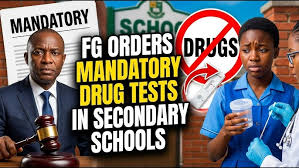
The Federal Government of Nigeria officially launched a new policy today, May 11, 2026, mandating compulsory drug integrity tests for secondary school students nationwide.
The initiative is part of a broader "National Guidelines on Drug Use and Prevention" framework aimed at curbing the rising tide of substance abuse within the school system.
Core Components of the Policy
Mandatory Entry Tests: All newly admitted students into secondary schools must undergo a drug test as part of the enrollment process.
Periodic Screening: Beyond admission, students will be subject to periodic and random drug testing throughout their academic tenure.
Rehabilitation Over Punishment: The government has emphasized that the policy is not intended to be purely punitive. Students who test positive will be referred for treatment and rehabilitation.
Temporary Suspension: However, the policy includes provisions for the temporary suspension of students who repeatedly test positive or refuse to participate in prescribed rehabilitation programs.
Implementation and Rationale
The Minister of Education, Dr. Tunji Alausa, and health officials highlighted that the policy is a response to alarming data regarding drug use among adolescents.
Early Intervention: By testing at the point of entry, the government aims to identify at-risk youth early and provide necessary psychological and medical support.
Security and Environment: The measure is also linked to improving school safety, as drug abuse is frequently connected to cultism and violent behavior in schools.
Curriculum Integration: This testing mandate is paired with a new secondary school curriculum that integrates drug education to teach students about the dangers of various substances.
Stakeholder Reactions
While the government views this as a necessary step for public health, the move has sparked immediate debate:
Support: Many parent-teacher associations (PTAs) and school administrators have welcomed the move, citing the need for "drastic measures" to protect children from the influence of drug cartels.
Concerns: Human rights advocates and some education experts have raised questions regarding the privacy of minors, the potential for stigmatization of students who test positive, and whether schools have the adequate infrastructure to handle sensitive medical data.
The National Drug Law Enforcement Agency (NDLEA) is expected to provide technical support and oversight for the testing kits and procedures used by schools to ensure accuracy and fairness.