
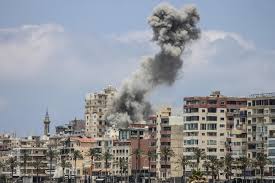
US-Iran Tensions Explode as Trump Launches Retaliatory Strikes Following Apache Shootdown
The fragile, two-month-old ceasefire in West Asia is on the verge of total collapse following a rapid, high-stakes military escalation between the United States and Iran.
The latest crisis ignited after a U.S. Army AH-64 Apache attack helicopter was shot down over the strategically vital Strait of Hormuz. In immediate retaliation, U.S. President Donald J. Trump ordered a wave of "self-defense" airstrikes against Iranian coastal targets, triggering a massive wave of Iranian missile and drone counter-attacks across three Middle Eastern countries.
The Spark: A High-Tech Sea Rescue in the Strait
The crisis began when a U.S. Army Apache helicopter, operating a patrol flight off the coast of Oman to enforce blockades on Iranian crude oil shipments, was brought down.
In a historic military first, the two American aviators were rescued from the water after two hours by a 24-foot unmanned surface vessel named Corsair (manufactured by Saronic Technologies), deployed by U.S. Naval Forces Central Command (CENTCOM) and Task Force 59.
President Trump quickly took to social media to confirm the crew’s safety and directly accuse Tehran:
Flashpoint: The 24-Hour Cycle of Violence
The downing of the Apache—the second crewed U.S. aircraft lost in the conflict following an F-15 fighter jet in April—shattered a tenuous truce that had held since April 8. Within hours, words turned into devastating kinetic action.
1. The American Kinetic Response
At approximately 5:00 PM ET, acting on the Commander-in-Chief's orders, CENTCOM unleashed what it termed "proportional self-defense strikes." American fighter jets targeted:
Radar arrays and communication nodes near the Strait of Hormuz.
Air defense batteries and ground control stations along Iran's southern coast.
Heavy explosions were reported by Iranian state media (IRIB) on Qeshm Island and across the coastal cities of Jask, Sirik, and Bandar Abbas.
Conversation with Gemini
you are a journalst, do a news report for the headline ;Tinubu Establishes Ebola Task Force, Releases ₦10 Billion Emergency Fund
THE RECONSTRUCTIONIST Special Report | Public Health & National Security
Tinubu Establishes Ebola Task Force, Releases ₦10 Billion Emergency Fund to Shield Nigeria
ABUJA, Nigeria — In a decisive, proactive strike against a looming regional health crisis, President Bola Ahmed Tinubu has authorized the immediate release of ₦10 billion in emergency intervention funding and established a high-powered presidential task force to insulate Nigeria from a potential Ebola outbreak.
The Guardian Nigeria News
The sweeping directives follow an alarming spike in Ebola Virus Disease (EVD) cases across the Democratic Republic of Congo (DRC) and Uganda, which has already claimed hundreds of lives and prompted the World Health Organization (WHO) to declare a Public Health Emergency of International Concern.
The Guardian Nigeria News
Bolstering the Frontlines: The ₦10 Billion Injection
The newly approved ₦10 billion emergency fund is earmarked entirely for national readiness. According to a statement released by the Special Adviser to the President on Information and Strategy, Bayo Onanuga, the capital will directly reinforce the operational capacity of the Nigeria Centre for Disease Control and Prevention (NCDC).
The Star
+ 1
The funding will accelerate the procurement of medical countermeasures, diagnostic kits, personal protective equipment (PPE), and support nationwide public health emergency activities to ensure early detection and containment.
The Guardian Nigeria News
The Gbajabiamila-Led Command
To ensure seamless execution, President Tinubu has constituted the Presidential Task Force on Ebola Virus Disease Preparedness and Emerging Public Health Threats.
The Star
The task force will be chaired by the Chief of Staff to the President, Rt. Hon. Femi Gbajabiamila. It bridges the gap between federal strategy and state-level execution, comprising key representatives from state governments and critical Ministries, Departments, and Agencies (MDAs), including:
BusinessDay
+ 1
The Ministry of Interior
The Guardian Nigeria News
The Federal Airports Authority of Nigeria (FAAN)
The Guardian Nigeria News
The Nigeria Immigration Service (NIS)
The Guardian Nigeria News
The Nigerian Civil Aviation Authority (NCAA)
The Guardian Nigeria News
The Lagos State Government
The Guardian Nigeria News
The formal creation of this team materialized immediately following an emergency cross-agency stakeholder meeting convened at the State House to map out Nigeria’s vulnerabilities.
The Guardian Nigeria News
Tightening the Borders: New Airport & Transit Protocols
Recognizing that aviation is the primary vector for cross-border transmission, the Presidency has ordered immediate, stringent changes to Nigeria's international travel workflows.
BusinessDay
Intervention Area Newly Mandated Emergency Measure
High-Risk Route Surveillance Heightened monitoring and scrutiny of passengers arriving via regional carriers, including RwandAir, Air Uganda, Kenya Airways, Ethiopian Airlines, Air Tanzania, and TAAG Angola Airlines.
Border Infrastructure Immediate activation of state-of-the-art referral and isolation centers at Lagos and Abuja international airports, with secondary hubs to follow.
Digital Tracking Mandatory deployment of QR-code-based pre-arrival health declaration systems for travelers originating from or transiting through designated EVD hotspots.
Sanitation & Control Strict crowd-control protocols, intensified thermal temperature screening, and continuous chemical disinfection of airport departure halls, baggage areas, and cargo hubs.
A Directive to Border States
In tandem with federal measures, President Tinubu has issued a strict mandate to all governors of states hosting international airports or sharing international land borders. These states, alongside relevant MDAs, have been given a short window to submit comprehensive preparedness blueprints, estimated funding requirements, and specific intervention needs to the Gbajabiamila task force for synchronized federal support.
BusinessDay
+ 1
Furthermore, the advisory body has been directed to consult with diplomatic, security, and aviation authorities to regulate, redirect, or adjust flight schedules from heavily impacted nations to minimize any interaction between high-risk passengers and the general public.
The State House, Abuja
The Bottom Line
Memories of Nigeria's heroic 2014 containment of Ebola remain fresh in the national psyche. By deploying billions in capital and standing up an executive task force before a single case crosses into the country, the Tinubu administration signals a zero-tolerance approach to public health complacency.
The Guardian Nigeria News
The message from the State House is clear: Nigeria will not wait to react; it is preparing to defend.
You are a journalist, do a news report on the headline ;Senate Pushes for Total Ban on Foreign Textile Imports
THE CAPITAL CHRONICLE National Assembly & Economic Policy Intelligence
Senate Pushes for Total Ban on Foreign Textile Imports to Resurrect Dying Local Industry
ABUJA, Nigeria — In a bid to halt massive capital flight and address severe domestic unemployment, the Senate has passed a sweeping resolution urging the Federal Government to impose an outright ban on the importation of all foreign textile materials.
THISDAYLIVE
The upper legislative chamber declared that halting the relentless influx of cheap foreign fabrics is the only viable lifeline remaining to revive Nigeria’s collapsed textile sector. Lawmakers warned that the country’s current reliance on foreign nations for over 80% to 99% of its clothing needs has crippled local manufacturing and bled trillions of naira in foreign exchange.
Africa Updates
+ 1
The Katung Motion: From "Textile City" to Ghost Towns
The resolution followed a compelling motion titled “Urgent Need to Revive the Textile Industries in Nigeria,” spearheaded by Senator Sunday Marshall Katung (APC, Kaduna South) and co-sponsored by nine other lawmakers, including heavyweight senators such as Adams Oshiomhole, Natasha Akpoti-Uduaghan, and Mohammed Tahir Monguno.
The Nation Newspaper
Leading the debate, Senator Katung painted a stark picture of a once-glorious sector that has deteriorated into a shadow of its former self.
“In the 1970s and 1980s, Nigeria boasted about 167 vibrant textile mills employing over 500,000 citizens directly,” Katung stated. “It was the nation’s second-largest employer after the Federal Government, generating over $2 billion annually. Today, because the import ban was lifted in 2010, our markets are flooded with textiles from China, Indonesia, and Taiwan, leaving our own factories abandoned.”
News Agency of Nigeria
+ 2
Lawmakers noted that Kaduna—once proudly nicknamed Africa’s “Textile City” due to giants like Arewa Textiles Plc and United Nigerian Textiles Limited—has seen its industrial hubs turn into economic ghost towns, throwing thousands out of work and fueling regional insecurity.
News A