
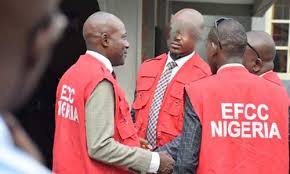
18 states under investigation over fund mismanagement – EFCC
The Economic and Financial Crimes Commission has revealed that approximately 18 states are presently under investigation due to allegations related to the mismanagement of public funds.
During an interview on Arise Television on Thursday, the commission’s Director of Public Affairs, Wilson Uwujaren, made this announcement but refrained from disclosing the names of the states involved.
Uwujaren addressed inquiries regarding the commission’s decision to freeze an account belonging to the Osun State Government, indicating that this was one of several similar measures the EFCC had undertaken or was planning to implement against various state governments.
When directly asked if other states were under investigation, Uwujaren confirmed that the number was indeed in double digits.
“Like we said in the statement, there are about 18 other states that we have ongoing investigations,” he said.
Pressed to name the states, he declined.
“I don’t want to start mentioning those states by name now,” he said.
When the interviewer suggested he should disclose the states with ongoing investigations, arguing that Nigerians deserved to know, Uwujaren held his ground, insisting the reluctance was strictly to protect the integrity of the probes and not to help any government evade scrutiny.
“Not running away per se, but not to jeopardise the investigation that is currently ongoing,” he said.
Uwujaren said the commission’s action against Osun State was not an isolated case, noting that a similar restriction had previously been placed on an Edo State Government account before the emergence of Governor Monday Okpebholo.
“Before, during the Edo State government, the Edo State election, before the coming of Governor Okpebholo, EFCC also took actions to restrict the account of that state government when we saw that funds were being moved to suspicious accounts.
“And we were able to preserve $12 billion for them. That is why the current government was able to come on board and have resources to work,” he said.
He said the commission’s interventions were guided by law and not directed at any particular administration.
“So this is not targeted at any particular government. We are simply doing our work under the law,” he said.
When questioned about why the commission did not undertake comparable measures during the Ekiti State election, Uwujaren explained that the situations were distinct, referencing intelligence that was exclusively available to the commission.
“If you talk about what happened in Ekiti, we didn’t have any reason to intervene the way we are intervening now. And you don’t have access to the information that we have access to,” he said.
On the scope of the Osun State restriction, Uwujaren reiterated that only one statutory account had been affected, with the state government retaining access to its other accounts.
“We only targeted one statutory account, which is restricted, temporary restriction on that account. And it does not stop the government from operating other accounts that they have. It’s only one account that is frozen for now,” he said.
He said the commission had a 72-hour window within which to obtain a court order to sustain the restriction or lift it, adding that the window had not lapsed.
“We have a 72 hours window to obtain a court order, which the commission is at liberty to do.
“We have not exhausted that window, 72 hours, within which we either obtain a court order to continue to freeze it or lift the restriction on the other hand,” he said.
Reacting to the Osun State Government’s plan to approach the court over the freeze before the commission could act, Uwujaren said the state was within its rights to do so, adding that the EFCC would respond appropriately.
“It’s within their right to take that decision today. If we think they are right to take that decision, we are also working on what we should do as an agency,” he said.
Uwujaren also cited Section 34 of the EFCC Act and Section 7, Subsection 6 of the Money Laundering (Prohibition) Act 2022 as the commission’s legal basis for restricting accounts, noting that the powers applied broadly and were not limited to state governments.
“Absolutely. Those two provisions give us the power to place temporary restrictions on any account, not only limited to state government, on any account that we suspect that there are suspicious activities on those accounts.
“And we have 72 hours between which to produce a court order to continue to restrict those accounts or lift the restriction,” he said.
He maintained that the Osun State investigation was not a recent development, noting that it began in March and had already involved the questioning of some state officials.
“But as it is now, I want to restate the fact that the Osun State case didn’t start today. It started way back in March. And a number of officials from that state have been interviewed in course of this investigation. So it didn’t just begin now,” he said.
The revelation of ongoing investigations in 18 states is expected to increase scrutiny of state government finances across the nation, following the commission's recent limitation on the Osun State account, which has faced criticism from both the state government and the Nigerian Bar Association.