
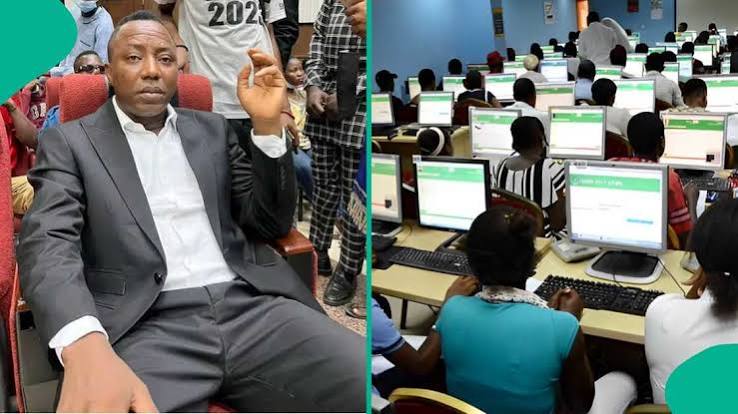
If I win, education will be free – Sowore
Human rights activist and prominent opposition figure Omoyele Sowore has unveiled a radical, 20-point educational blueprint ahead of the 2027 general elections, promising entirely free education at all levels across Nigeria if elected to the presidency.
The presidential candidate of the African Action Congress (AAC) released the extensive policy document via his official X handle on Monday, July 13, 2026, declaring that under his administration, "knowledge will be treated as a right, not a privilege."
A core pillar of Sowore’s manifesto is the complete abolition of fees for all national and regional public examinations. The announcement is acutely timed, landing immediately after intense public outcry forced the Federal Government to freeze a proposed 82% hike in West African Examinations Council (WAEC) and National Examinations Council (NECO) registration fees.
Under the proposed AAC framework, the economic burden of these baseline certifications would shift entirely to the state.
"No government under a #Sowore2027 administration will ever ask your child to pay WAEC, NECO, or any other public examination fee," Sowore asserted. "Our revolutionary education policy guarantees free, high-quality education from early childhood through university."
[Early Childhood] ➔ [Primary & Secondary] ➔ [University / Tech Degree]
ALL LEVELS: ₦0 TUITION & ₦0 EXAM FEES
The manifesto goes beyond funding, outlining a structural reorganization of the Nigerian schooling model. Sowore is proposing a transition from the traditional system to a *5-5-4 structure*:
*5 Years* of Primary Education
*5 Years* of Secondary Education
*4 Years* for a standard University Degree
To bridge the gap between secondary education and career development, the blueprint mandates that every Local Government Area (LGA) establish a community college. These colleges will offer two-year associate degrees, technical certifications, and digital skill tracts designed for immediate employment.
Furthermore, the document dictates a comprehensive polytechnic reform, stating that all existing polytechnics and monotechnics nationwide will be systematically upgraded into full-fledged universities.
Addressing the perennial strikes and funding shortfalls that plague Nigeria's public tertiary institutions, the manifesto outlines aggressive student and staff welfare packages. Students in public universities would receive dedicated **semester education grants** to cover their living and academic expenses, a move intended to offset the cost-of-living crisis.
For teachers and lecturers, the plan promises a "Teachers First" initiative featuring upgraded salary structures, housing allowances, and robust research grants.
SOWORE 2027 INFRASTRUCTURE TARGETS
National Education & Innovation Cloud (AI & Open Data) Renewable Electricity & Campust-Wide Internet
AI-Powered "Smart Hostels" & Modern Laboratories │
The document also emphasizes heavy technological integration, proposing a "National Education and Innovation Cloud." This centralized digital hub would provide students and teachers free access to global academic journals, open-source educational software, virtual laboratories, and AI learning assistants. Physical campus upgrades would feature renewable electricity grids, disability access, and AI-powered "smart hostels."
Sowore, a veteran activist who led the University of Lagos Student Union Government in the early 1990s, dismissed critics who argue that Nigeria cannot afford an entirely free education system.
Reiterating arguments he has championed across multiple election cycles, the *Sahara Reporters* founder insisted that Nigeria's economic resources have historically been mismanaged through "corporate welfare" and systemic corruption. He argued that plugging financial leakages and redirecting the state's crude oil revenues would easily fund the entire system indefinitely.
"This is not a promise of politics," Sowore concluded. "It is a revolutionary commitment to build a nation where no Nigerian will be denied education because of poverty."