
Catholic bishops’ inconvenient truth
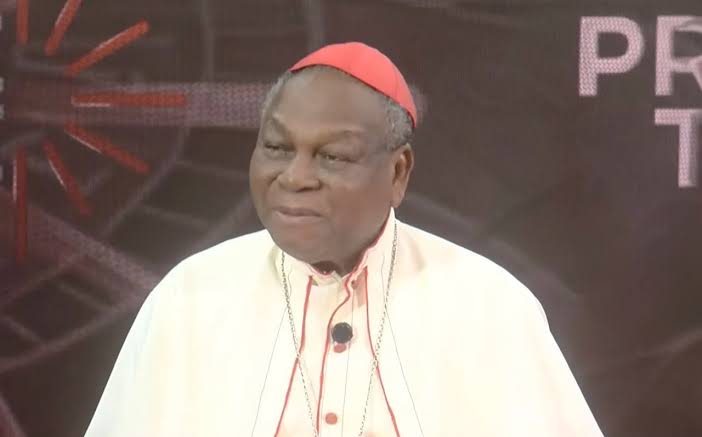
Politics and religion frequently intertwine, resulting in a detrimental mix. This is evident in the controversy surrounding John Onaiyekan’s remarks following the recent meeting between President Bola Tinubu and the Catholic Bishops’ Conference of Nigeria. As tensions rise, this encounter reveals underlying issues within the government rather than the cardinal’s true intentions.
Rather than viewing the bishops’ comments as genuine moral guidance from a respected body, some defenders of the administration resorted to personal attacks, accusing the cardinal of partisanship and misusing his clerical authority.
Such a reaction was regrettable and could have been avoided.
No elected government that claims to uphold democratic values should interpret independent criticism as an act of hostility.
However, the intense backlash from the Minister of the FCT, Nyesom Wike; the President’s Special Adviser on Policy Communication, Daniel Bwala; and the SSA on Media, Temitope Ajayi, indicated that Onaiyekan had committed a serious transgression by stating that the bishops informed the President that Nigeria was “bleeding,” that poverty was escalating, and that many citizens were struggling due to economic reforms.
The cardinal’s error was not in distorting the truth but in publicly addressing a difficult conversation.
He noted that the President disagreed, asserting that the economy was on the mend and that reforms were establishing a foundation for recovery.
According to him, the bishops neither anticipated agreement nor aimed to embarrass the President; they were fulfilling a moral obligation to convey what many Nigerians could not express.
This should have concluded the discussion. Instead, critics transformed a constructive dialogue into a public dispute. Bwala questioned the cardinal’s impartiality, claiming the church had supported Peter Obi in the 2023 elections.
Ajayi dismissed the bishops as presenting a singular viewpoint. Wike contended that the cardinal’s previous electoral stance disqualified him from being neutral and criticized the bishops for questioning INEC’s impartiality ahead of the 2027 elections without more substantial evidence.
These points deserve attention. Religious leaders, akin to journalists and civil society representatives, should strive for impartiality, as their credibility hinges on intellectual integrity. It is essential to recognize the accomplishments of the government. However, fairness must be reciprocal.
The supporters of the administration owe the Nigerian populace a sincere engagement with the substance presented by the bishops, rather than resorting to efforts aimed at discrediting the messengers.
The choice made by the cardinal in terms of voting is inconsequential to the fact that millions of Nigerians are enduring hardship. Hunger and inflation do not discriminate based on political affiliation before impacting families.
One of the least effective responses to public criticism is to question motives while neglecting the issues raised. This approach has failed to persuade many Nigerians. Consequently, it is not surprising that support for Onaiyekan emerged from various sectors of civil society.
The Northern Youth Council stated that he embodies the realities of life; the Middle Belt Forum deemed the attacks unjust; the Catholic Laity Council upheld the church’s obligation to advocate for the vulnerable.
Former governor and minister Rotimi Amaechi, who is also a Catholic, reminded the Presidency that bishops possess the right to critique governments and called for responses grounded in evidence rather than indignation.
Even Orji Kalu, an APC senator and former governor of Abia State, warned of his potential resignation from the party if the bishops faced insults, highlighting their similar interventions throughout Africa.
The public outcry seems to have led to a more tempered response. The Secretary to the Government of the Federation, George Akume, reiterated the administration’s respect for the Catholic Church and pledged to engage in more thorough consultations.
This is the prudent response one would expect from a self-assured government, and it should have been the initial reaction.
This incident reveals a more profound issue.
With the 2027 elections approaching, there is an increasing inclination within official circles to view every criticism through a partisan perspective.
Independent institutions that choose not to align with the government's agenda may be labeled as adversarial. Such a defensive stance does not benefit democracy or effective governance.
Onaiyekan made a pointed observation that too many individuals surrounding the President present an excessively optimistic view of the nation. While this may not be entirely accurate, it underscores a significant risk: administrations surrounded by sycophants and loyalists may confuse adulation with genuine patriotism.
Presidents require more than just briefings, official data, and complimentary presentations. They must be informed of uncomfortable realities by independent voices, including economists, labor unions, journalists, business leaders, traditional authorities, and religious organizations.
Governments that choose to ignore dissent become disconnected from the populace they serve. This is why criticism should not be viewed as an obstacle to reform; rather, it is silence that poses a threat.
The Tinubu administration can justifiably claim it inherited a severely troubled economy, necessitating tough decisions. The removal of the petrol subsidy and the liberalization of the foreign exchange market were politically challenging but, as many economists concur, were economically unavoidable.
The government has broadened fiscal capacity for states, established NELFUND, initiated youth programs, and contributed to ending the damaging cycle of prolonged ASUU strikes. These accomplishments are significant and warrant recognition.
However, governments are evaluated based on the lived experiences of their citizens, not solely on economic theories or improving macroeconomic indicators.
Foreign reserves have increased to $52 billion from approximately $3 billion, fiscal revenues have reached unprecedented levels, and the naira exchange rate has stabilized following the initial post-reform turmoil.
Nevertheless, these improvements have not translated into substantial relief for the average Nigerian. Inflation remains severe at over 15 percent, exceeding 37 percent in at least ten states; the costs of food and transportation are rising sharply; healthcare and medications are expensive; electricity tariffs and rents have surged; and small businesses are grappling with high energy expenses and costly credit.
For numerous families, over 70 percent of their income is allocated solely to food expenses. According to the World Bank, multidimensional poverty impacts 63 percent of Nigerians.
The bishops aimed to convey this reality, which cannot be overlooked by merely referencing positive macroeconomic trends.
The ongoing reforms remain unfinished. A parallel foreign-exchange market continues to exist, indicative of distortions and a lack of confidence.
Oil production is still falling short of expectations. Domestic refiners express concerns over insufficient crude supply, even as the government advances Project Gazelle with a new $4.5 billion refinancing, raising apprehensions about future crude commitments while plans to double local refining capacity are underway.
External debt continues to escalate, heightening exposure to exchange-rate fluctuations and increasing debt-service obligations, which already account for half of the revenue.
Terrorism, banditry, and kidnapping persistently threaten vast areas of the country, displacing farmers from fertile lands and exacerbating food inflation.
Official and independent reports reveal that since 2023, more than 628,000 individuals have lost their lives and over 2.2 million have been abducted, as reported by BusinessDay in June.
These are quantifiable national realities, not mere talking points for the opposition. Governments require independent voices to address these issues candidly. No amount of denial can obscure the fact that Nigeria is in distress.
The Catholic Church has a longstanding tradition of moral advocacy. During periods of military rule, bishops like Olubunmi Okogie, an Emeritus Cardinal, denounced authoritarianism, corruption, and violations of human rights.
In democratic contexts, the church has continued to hold administrations accountable across the political spectrum regarding issues of insecurity, governance failures, and human suffering. Its allegiance lies with moral principles rather than any political party.
Tinubu should not perceive himself as uniquely victimized, nor should his supporters confuse clerical advocacy with partisan politics.
Religious leaders are primarily citizens. They conduct funerals for victims of terrorism, provide guidance to unemployed graduates, offer solace to widows, and nourish families in need. If these leaders are unable to address issues such as poverty, insecurity, and governance, democracy risks becoming a mere illusion.
Political parties also exhibit inconsistency. Many individuals who currently advocate for the removal of the petrol subsidy previously opposed it when it was introduced un