
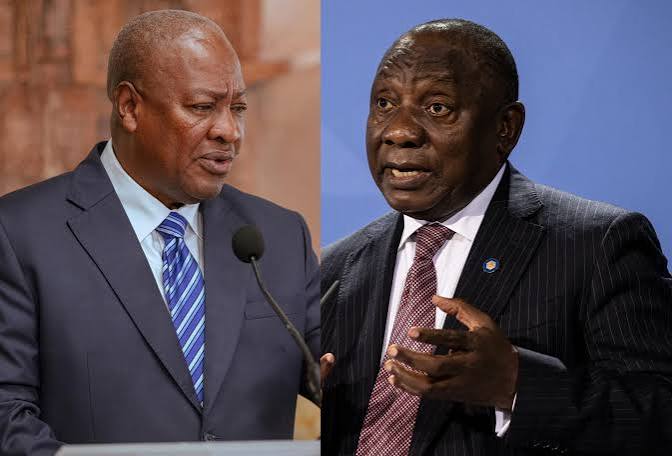
Ghana Declines State Visit By South African President Ramaphosa Over Xenophobic Attacks
In a major diplomatic rift that exposes widening fractures over African unity, the Ghanaian government has officially deferred a planned August visit by South African President Cyril Ramaphosa.
Accra took the drastic step following intense public anger and escalating tensions over a fresh wave of violent anti-immigrant protests in South Africa, which have disproportionately targeted Ghanaian nationals and triggered a mass repatriation effort.
The Catalyst: Death, Viral Videos, and Mass Evacuations
The immediate trigger for the diplomatic freeze was the death of 40-year-old Ghanaian fashion designer Bahiru Isak, who was shot and killed on June 30 during anti-immigration demonstrations in the Khayelitsha township of Cape Town. While Accra officially condemned the killing as a tragic act of xenophobia, Pretoria strongly contested the narrative, claiming no fatalities occurred during the June 30 protests.
Tensions have been further fueled by a viral video showing a young Ghanaian in South Africa, Emmanuel Asamoah, being aggressively confronted by locals and told to "go fix his country."
Fearing for the safety of its citizens, Ghana has already repatriated more than 900 of its nationals from South Africa, with another batch of over 900 scheduled for evacuation.
Diplomatic Finger-Pointing
Announcing the postponement, Ghanaian government spokesman Felix Kwakye Ofosu stated that holding the high-profile meeting under current conditions would be entirely counterproductive.
We sent them a communication indicating that it would be best to defer the visit in view of the present climate around xenophobia. Recent violence in the country was liable to overshadow the meeting's priorities."
Felix Kwakye Ofosu, Ghanaian Government Spokesman**
Even the exact nature of the canceled trip has become a point of public bickering. While Ghana described it as a formal "State Visit" meant to ease tensions, South African authorities downplayed the framing. Pretoria insisted it was simply a routine bilateral meeting to co-chair a joint binational commission and claimed Ramaphosa chose to delay the trip himself rather than being turned away.
South African presidential spokesperson Vincent Magwenya reiterated Pretoria's commitment to "deepening cooperation," but other South African officials struck a harsher tone. The country's Justice Minister openly accused Ghana of spreading "false information regarding developments on irregular migration," while a presidential spokesperson accused Ghana’s foreign ministry of engaging in "anti-South African rhetoric."
The Core Dispute: Legality vs. Discrimination
At the heart of the standoff is a fundamental disagreement over immigration status. Ghana maintains that the vast majority of its citizens living in South Africa possess legal residency papers and are being unfairly targeted by vigilantes. South Africa counterclaims that the protests are a domestic pushback against a rise in undocumented, irregular migration. Neither country has yet made public data backing their claims.
The broader fallout could have severe consequences for South Africa’s standing on the continent. In May, Ghana formally petitioned the African Union (AU) to intervene, arguing that recurring xenophobic attacks violate the spirit of the African Continental Free Trade Area (AfCFTA) agreement and actively dismantle Pan-African solidarity.
Geopolitical analysts warn that if South Africa fails to curb the recurring violence and manage the political fallout, it faces growing diplomatic isolation from major continental allies like Ghana. For now, the borders remain open, but the political bridge between Accra and Pretoria has effectively been closed.