

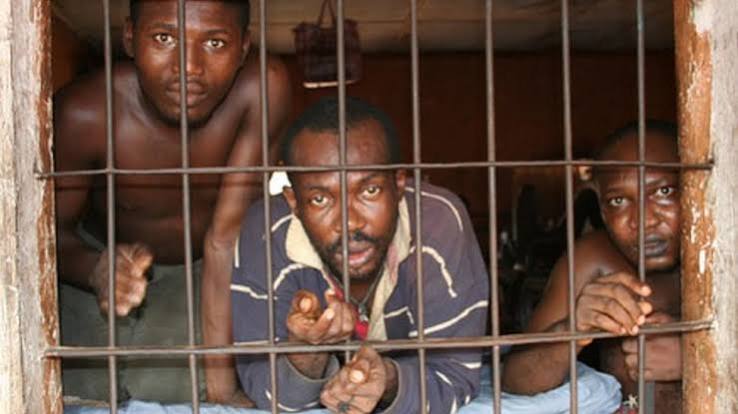
Delayed justice, crowded cells: Over 80,000 rot in Nigerian prisons
Across Nigeria’s 256 custodial facilities, more than 80,000 individuals remain incarcerated in conditions well beyond designed national capacity. Official figures from the Nigerian Correctional Service (NCoS) reveal that roughly 64% to 70% of all inmates have never been convicted of a crime
Instead, tens of thousands languish on pre-trial remand—trapped in a web of lost case files, rigid bail terms, and systemic court delays.
| Total Inmate Population | 80,812 | Exceeds cumulative national design capacity (~50,000–58,000).
| Awaiting Trial Inmates (ATI) | 51,955 (~64%–70%) | Majority spend years behind bars without receiving a verdict. |
| Convicted Inmates | 24,913 | Account for less than one-third of total prison occupancy. |
| Death Row Inmates | 3,688 | Growing backlogs due to state governors' hesitation to sign warrants or commute sentences. |
1. Poverty as a Primary Driver of Incarceration
Human rights observers and the National Human Rights Commission (NHRC) highlight economic inequality as a major engine driving custodial congestion. Thousands of low-risk offenders accused of petty infractions remain in high-security facilities simply because they cannot afford minor court-imposed fines or legal representation.
"Most crimes that bring people into custody are often rooted in poverty, and when you look at the fines that continue to keep low-risk inmates behind bars, you can see how poverty and inequity sustain overcrowding in our correctional facilities."
Dr. Tony Ojukwu, SAN, Executive Secretary, National Human Rights Commission (NHRC)
2. Slow Judicial Machinery & Protracted Remand
Inordinate trial adjournments, inadequate public defender coverage, and slow police investigations mean defendants frequently spend more time in pre-trial detention than the maximum sentence for their alleged offense. In severe cases, "forgotten inmates" remain locked up because physical case dockets were lost during transfers.
3. Underutilized Non-Custodial Options
Although the Nigerian Correctional Service Act established frameworks for parole, probation, mobile courts, and community service, lower courts routinely default to pre-trial remanded detention. Funding gaps for non-custodial supervision at local government levels further limit implementation.
Civil society organizations and human rights groups report severe physical deterioration across major urban custodial centers:
CONDITIONS AT A GLANCE
• Overcrowded Cells: Cells designed for 4 inmates often hold 10–15.
• Health Hazards: Heightened risk of communicable diseases due to inadequate sanitation and medical access.
• Feeding Budgets: Daily feeding allowances face severe inflationary
pressures despite recent federal budget increases.
The human toll was highlighted by recent legal interventions from advocacy groups, such as the Tunji Braithwaite Foundation, which petitioned courts to enforce urgent medical evacuations for critically ill inmates facing trial without access to tertiary hospital care.
During legislative budget hearings, NCoS leadership presented an expanded budget request seeking increased capital funding for facility expansion, alongside dedicated allocations to establish non-custodial infrastructure across all 774 Local Government Areas.
Concurrently, state-level initiatives—including plea bargain frameworks, mobile courts, and fine-clearing exercises by civic organizations—are offering localized relief. However, justice experts emphasize that long-term decongestion requires systemic police, prosecutorial, and judicial reforms rather than expanding prison walls alone.