
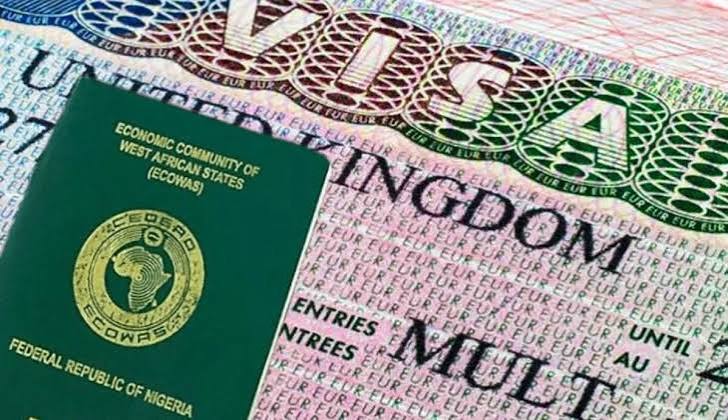
1.34 million Nigerians denied UK visas in 21 years
A teacher has been confirmed deceased, and numerous students have been abducted from Government Day Secondary School in Lassa, located in the Askira/Uba Local Government Area of Borno State, which borders Adamawa State.
Mr. Solomon Kwamagar, the Special Adviser to the Governor of Adamawa State, Ahmadu Fintiri, on Media and Strategy, and a resident of Lassa, verified the occurrence on Monday morning.
He revealed that the assailants arrived on motorcycles and stormed the school.
"Today marks Lassa market day. I was informed that they accessed the area via the market on motorcycles and proceeded to Government Day Secondary School, Lassa. They shot and killed one teacher and abducted all the students present in their classrooms," he stated.
Kwamagar continued, "Lassa in Borno State is primarily populated by my people, the Margi. We inhabit both Adamawa and Borno states. Although I am originally from Lassa, I have chosen to live in the Madagali Local Government Area of Adamawa State."
He also mentioned, "I am still reaching out to determine the exact number of students and teachers who were taken from the school."
When the spokesperson for Adamawa State was contacted by the Police Command, SP Suleiman Nguroje, for verification, his phone was turned off.
The statistics are derived from the UK Home Office’s datasets on entry clearance visa outcomes, which span from the first quarter of 2005 to the first quarter of 2026. These figures were sourced from the UK government's immigration system statistics data tables published in 2026.
This dataset encompasses all decisions related to visitor, study, work, family, and other visa categories.
For Nigeria, the cumulative refusal rate over the 21-year span was recorded at 33.1 percent, which is more than double the global average of 14.8 percent for the UK.
Out of approximately 4.09 million applications submitted by Nigerians, 4,068,153 received either issued or refused decisions.
The 1.34 million refusals from Nigeria represented 15.2 percent of the total 8,829,638 UK visa refusals worldwide.
Throughout the two decades, roughly one in every seven UK visa rejections was attributed to a Nigerian applicant, despite Nigerians submitting only 6.8 percent of all global applications.
Visitor visas were predominant in both the approvals and rejections. Among the 1,344,595 applications refused for Nigerians, 1,127,088, or 83.8 percent, were in the visitor category, which experienced a refusal rate of 37.1 percent over the entire period.
Rejections for study visas totaled 130,712 at a rate of 20.5 percent, while work visa rejections amounted to 41,410 at 16 percent, and family refusals were recorded at 12,217.
In 2025, the number of visitor visa refusals alone reached 66,143, compared to 105,039 issued, resulting in a rejection rate of 38.6 percent.
By the first quarter of 2026, 13,779 visitor visa applications had already been denied, reflecting a 37.5 percent refusal rate.
The period with the highest refusal rate occurred in the mid-2000s, particularly in 2006, when the UK rejected 117,968 Nigerian applications, resulting in a refusal rate of 49.6 percent.
Refusals also peaked at 111,058 in 2005, with a refusal rate of 44.4 percent.
However, the figures improved over the following decade, with the refusal rate decreasing to 26.2 percent in 2011 and eventually reaching a recent low of 21 percent in 2023, when a post-pandemic surge led to a record 281,658 visa grants to Nigerian applicants.
The dataset recorded the highest single-year total with 249,332 grants in 2022 preceding it.
Nevertheless, the elevated acceptance rate was not sustained. In April 2024, the UK increased the minimum salary requirement for Skilled Worker visas from £26,200 to £38,700, marking a 48 percent rise, and imposed restrictions on dependent visa rights for students and care workers, which led to a decline in application numbers.
According to analysis by immigration research firm Intelpoint, Nigeria experienced a 68 percent decrease in work visa applications in 2024 after the salary threshold review disqualified many previously eligible roles.
In 2024, 77,706 Nigerians faced refusals at a rate of 33.5 percent, while in 2025, 77,571 were denied at a rate of 33.1 percent.
By the first quarter of 2026, 16,692 had been refused at a rate of 35.4 percent, surpassing the rates of the two preceding full years.
Nigeria led the list of nationalities with the highest number of UK visa rejections in Africa.
Out of a total of 3,027,198 UK visa refusals for all African nationalities during this period, Nigeria accounted for 1,344,595, which is 44.4 percent.
Ghana followed as the second highest among African nations with 374,108 refusals at a rate of 40.5 percent, followed by Algeria (191,903 refusals at a rate of 41.7 percent), Egypt (134,055 at a rate of 16.2 percent), Zimbabwe (102,246 at a rate of 26 percent), Morocco (93,722 at a rate of 22.2 percent), Kenya (75,973 at a rate of 18.8 percent), Uganda (64,759 at a rate of 34.9 percent), South Africa (61,521 at a rate of 3.6 percent), and Sudan (59,069 at a rate of 31 percent).
Overall, the UK processed 60,063,475 visa applications from all nationalities between 2005 and Q1 2026, granting 50,873,344 and denying 8,829,638.
African applicants submitted 11,433,508 of these visa applications, constituting nine percent of the global total, yet faced 3,027,198 refusals, which represents 34.3 percent of all UK rejections worldwide.
While African nations submitted nearly double the share of applications, they accounted for only about half the volume of refusals.
Nigeria accounted for 35.7 percent of all applications from Africa and secured 32.7 percent of the UK visas issued to African nationals.
The UK entry clearance visa system mandates that citizens from non-exempt countries, including Nigeria, must obtain formal authorization prior to their arrival.
Under the points-based immigration system established in 2008 and subsequently expanded post-Brexit, applicants are required to prove financial stability, a genuine intention to visit, and sponsorship for work and study pathways.
Decisions regarding visitor visas, which remain the most disputed category, rely on the assessment of financial documentation and the applicant’s connections to their home country by entry clearance officers.
Reports indicate that these criteria have historically resulted in elevated refusal rates for applicants from economies deemed high-emigration risk.
In the year ending September 2025, Nigerians were among the top five nationalities filing asylum claims after entering the UK with valid visas.
The Home Office has indicated that this trend has prompted it to impose stricter controls on visa and asylum approvals for Nigerians.
In an interview with our correspondent, Ogbole Amedu-Ode, a former Nigerian Ambassador to Singapore, stated that the desire to leave Nigeria is primarily driven by the country's struggling economy, with many citizens opting for the Japa route.
He contended that the trend of Japa may only diminish with substantial economic improvements in the country.
"The desire to emigrate is fundamentally linked to the performance of our national economy. The economic challenges have driven many compatriots into Japa mode.
"Regrettably, this trend may continue to rise until there is a significant turnaround in the national economy's performance," the former diplomat remarked.
He acknowledged that while the number of visa rejections is concerning, the overall volume of approvals helps to offset this issue.
Amedu-Ode further stated, "Even so, the concurrent rise in both approvals and rejections is a result of the increased number of our compatriots applying to travel to that region of the world."